Will Burlar Attempt Again After Failed Attempt
8.1 Effort
Learning Objectives
- Ascertain an inchoate crime.
- Distinguish between general and specific attempt statutes.
- Identify and draw the four tests jurisdictions apply to ascertain the criminal act element required for try.
- Define preparatory crimes.
- Define the criminal intent element required for attempt.
- Place ii potential defenses to attempt.
- Distinguish between factual and legal impossibility.
- Define voluntary abandonment.
- Describe merger and explain the way it affects attempt crimes.
- Analyze the relationship betwixt transferred intent and attempt.
- Distinguish between the grading of attempt and the completed law-breaking.
Attempt, conspiracy, and solicitation are considered inchoate crimes. Inchoate means "merely begun, incipient, in the early stages" (Yourdictionary.com, 2010). Inchoate crimes can be left unfinished, or incomplete. Although effort never results in the finished criminal crime, both conspiracy and solicitation could requite rise to split completed crimes.
The rationale supporting punishment for an inchoate criminal offense is prevention and deterrence. If a accused could non exist apprehended until a crime is finished, law enforcement would not exist able to intervene and avert injury to victim(s) or property. In addition, a defendant who is unable to complete a criminal offence would endeavour once again and again, free from whatever criminal consequences.
The difficulty in property a defendant accountable for an inchoate or incomplete crime is ascertaining the level of progress necessary to impute criminal responsibility, which is particularly daunting with attempt, because in every instance the crime is left unfinished, every bit is discussed in Section eight.1 "Endeavor".
Synopsis of the History of Attempt
At early English language mutual police, endeavour was non a crime (Schulhofer, Southward. J. and Kahan, D. M., 2010). Gradually, the constabulary evolved, and a defendant who committed endeavour resulting in severe damage was punished for a minor criminal offense, typically a misdemeanor. One of the commencement documented cases of endeavor was Rex v. Scofield, Cald. 397 (1784) (Schulhofer, S. J. and Kahan, D. Chiliad., 2010). In Scofield, a servant was convicted of a misdemeanor for attempting to burn down down his primary's business firm with a lighted candle. A subsequent case, Rex v. Higgins, 102 Eng. Rep. 269 (K.B. 1801), upheld an indictment for attempted theft and firmly established the criminal offense of attempt in English language jurisprudence. In modernistic times, most states criminalize attempt, the majority in statutes, except in some states that let common-law crimes. All the same, fifty-fifty in statutes, the give-and-take "try" is oft left undefined, forcing courts to derive the meaning from mutual-law principles.
Effort Statutes
In full general, there are two types of attempt statutes. Some states have general attempt statutes that set forth effort elements and apply them to any law-breaking (Tex. Penal Code, 2010). Other states and the federal authorities have specific attempt statutes that define attempt according to specified crimes, such as murder, robbery, or rape (eighteen U.s.a.C., 2011). Keep in listen that several states do not criminalize endeavor in a statute and consider information technology a common-law crime (Grill v. State, 2010).
Attempt Act
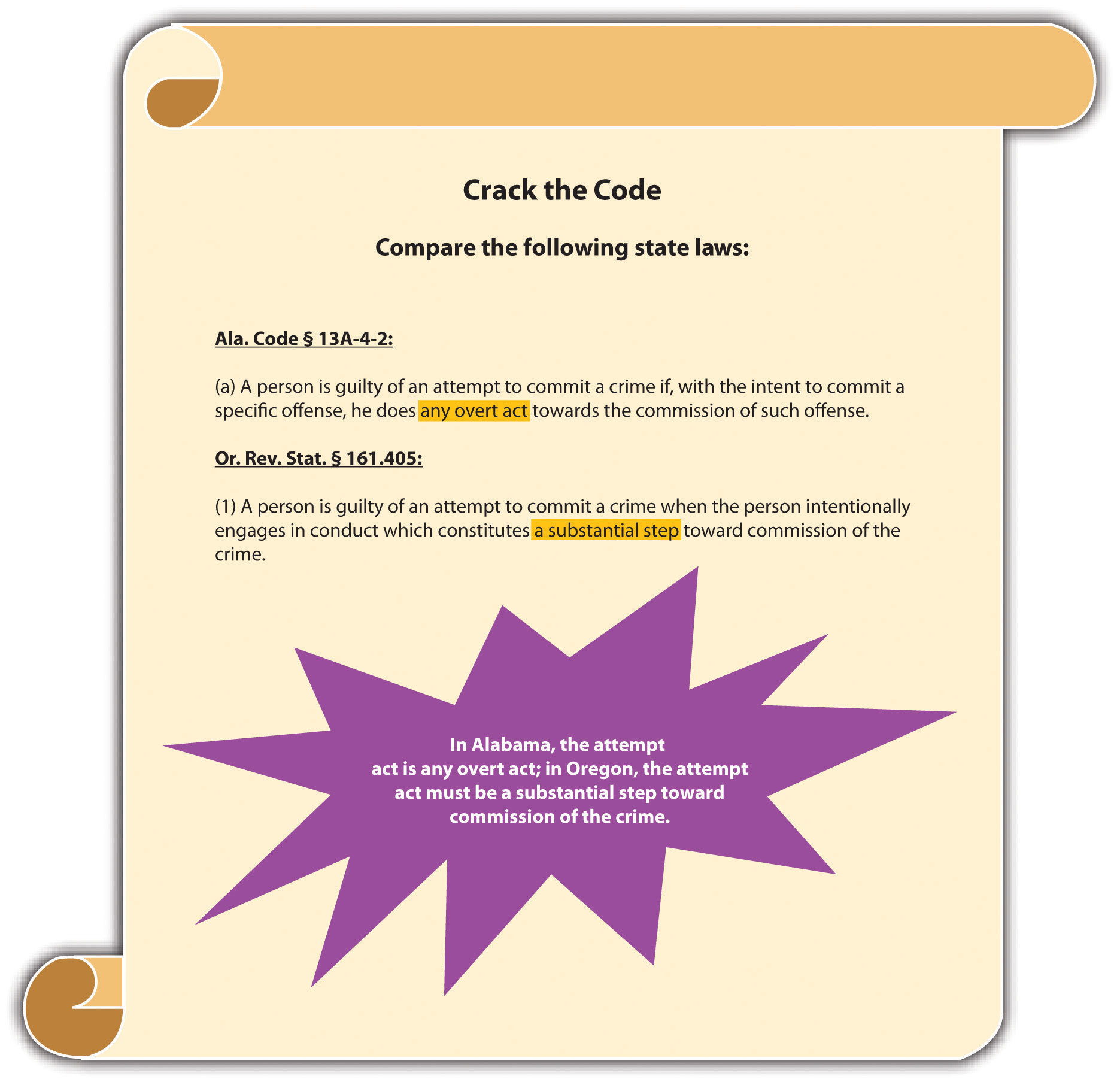
The criminal act element required for attempt varies, depending on the jurisdiction. As Chapter 4 "The Elements of a Offense" stated, thoughts are non criminal acts. Thus a accused does not commit try by plotting or planning an crime. An extension of this rule dictates that mere preparation is non plenty to constitute the attempt criminal human activity element (People v. Luna, 2010). However, the crux of any attempt example is how close to completing the offense the accused must get to fulfill the attempt criminal act requirement. In many statutes and cases, the try act is loosely defined to allow the trier of fact the flexibility needed to split up true criminal attempt from noncriminal preparation.
Jurisdictions use four tests to ascertain whether the defendant has committed the effort criminal act: proximity examination, res ipsa loquitur test, probable desistance test, and the Model Penal Code'south substantial steps test.
Proximity Examination
The proximity exam measures the defendant's progress by examining how shut the defendant is to completing the offense. The altitude measured is the distance between preparation for the offense and successful termination. Information technology is the amount left to exist washed, not what has already been done, that is analyzed (Commonwealth v. Hamel, 2010). In some jurisdictions, if the defendant'southward criminal intent is articulate, the defendant does not need to come as close to completion of the offense (People 5. Dillon, 2010). Generally, the defendant does not have to achieve the last step before completion (People v. Dillon, 2010), although many defendants do.
Case of the Proximity Test
Melissa and Matthew determine they want to toxicant their neighbor'due south canis familiaris because information technology barks loudly and consistently every dark. Melissa buys some rat poison at the local hardware store. Matthew coats a raw filet mignon with the toxicant and throws it over the debate into the neighbour's yard. Fortuitously, the neighbors are on an overnight camping trip, and the domestic dog is with them. The next day, subsequently a night of silence, Melissa feels regret and climbs over the fence to encounter what happened to the canis familiaris. When she sees the filet untouched on the ground, she picks it upwardly and takes it back over the fence, later disposing of it in the trash. If Melissa and Matthew are in a jurisdiction that follows the proximity examination, Melissa and Matthew have probably committed the criminal act chemical element required for attempt. Melissa and Matthew finished every act necessary to commit the criminal offense of destruction of property or animal cruelty (poisoning the dog). The only reason the crime was not successfully consummated was the absence of the dog, which is a circumstance outside their control. Thus Melissa and Matthew could near likely be charged with and convicted of this offense. If Melissa bought the rat poisonous substance only thereafter changed her mind and talked Matthew out of poisoning the dog, her actions would exist a grooming, non a positive step toward committee of the criminal offense. If Matthew coated the filet with poison but then changed his mind and threw the filet away, he would however be "also far" away from completing the crime. Even so, once the filet is thrown over the fence, the law-breaking is proximate to completion; the just step left is the victim's (domestic dog'due south) participation.
Res Ipsa Loquitur Test
Res ipsa loquitur ways "the thing speaks for itself" (USLegal.com, 2010). The res ipsa loquitur test, also called the unequivocality test, analyzes the facts of each example independently. Under res ipsa loquitur or unequivocality, the trier of fact must determine that at the moment the defendant stopped progressing toward completion of the offense, it was clear that the accused had no other purpose than commission of the specific crime at issue. This determination is based on the defendant's act—which manifests the intent to commit the crime (Hamiel v. Wisconsin, 2010).
Example of the Res Ipsa Loquitur Test
Harry wants to kill his wife Ethel for the proceeds of her life insurance policy. Harry contacts his friend Joe, who is reputed to exist a "hit man," and sets upward a meeting for the side by side day. Harry meets with Joe and asks him if he will murder Ethel for one thousand dollars. Joe agrees, and Harry pulls out a wad of greenbacks and pays him. Unfortunately for Harry, Joe is a law enforcement decoy. If the state in which Harry paid Joe recognizes the res ipsa loquitur or unequivocality test, Harry has about likely committed attempted murder (along with solicitation to commit murder, which is discussed shortly). Harry'south deportment in contacting and thereafter hiring and paying Joe to kill Ethel signal that he has no other purpose than the commission of Ethel's murder. Hiring and paying a hit homo is more than just training. Notation that evidence of Ethel'south life insurance policy is non needed to prove the attempt act. Harry'due south conduct "speaks for itself," which is the essence of res ipsa loquitur or unequivocality.
Probable Desistance Test
The probable desistance test examines how far the defendant has progressed toward committee of the crime, rather than analyzing how much the defendant has left to accomplish. Pursuant to this exam, a defendant commits attempt when he or she has crossed a line across which it is likely he or she volition not desist unless in that location is an interruption from some exterior source, police enforcement, or circumstances across his or her control (U.South. v. Mandujano, 2010).
Instance of the Probable Desistance Examination
Judy, who works at Zales jewelry shop, tells her Facebook friends that she is going to steal a diamond necklace out of the condom that evening. Judy drives to Zales at eleven o'clock after the store has closed. She enters the edifice using her cardinal and apace disables the shop alarm. She so turns off the store security photographic camera. As she crouches down by the safety and begins to enter the combination, all the lights become on and she blinks, startled by the sight of several law officers pointing their guns at her. If the state in which Judy lives follows the probable desistance test, Judy has most probable committed attempted larceny, along with break-in. Judy informed others of her plan, drove to the law-breaking scene, entered the building unlawfully, disabled the store alarm, and turned off the shop security photographic camera. This series of actions indicate that Judy crossed a betoken of no return. It is unlikely that Judy would have desisted without the police enforcement interruption, which fulfills the attempt act requirement pursuant to the probable desistance test.
Model Penal Code Substantial Steps Exam
The Model Penal Code developed the substantial steps test in response to the big variance between different jurisdictions in evaluating the criminal human action element required for attempt. The substantial steps examination is intended to analyze and simplify the attempt human activity analysis, to forbid arbitrary application. Information technology is as well a test that is more than likely to outcome in a confidence considering it classifies as "substantial" those acts the other tests might consider only "preparatory" (People v. Dillon, 2011).
The substantial steps test has two parts. Get-go, the accused must take substantial steps toward completion of the crime. Every bit the Model Penal Code states, "[a] person is guilty of an attempt to commit a crime if…he…does…annihilation which…is an act or omission constituting a substantial pace in a course of conduct planned to culminate in his commission of the crime" (Model Penal Code § 5.01(1)(c)). 2nd, the defendant's deportment must be "strongly corroborative of the histrion'due south criminal purpose" (Model Penal Code § v.01(two)). To further elucidate the test, the Model Penal Code provides seven examples of deportment that institute substantial steps, as long as they are corroborative of the accused's intent. The 7 examples are lying in wait; enticing the victim to go to the scene of the crime; investigating the potential scene of the crime; unlawfully entering a structure or vehicle where the crime is to be committed; possessing materials that are specially designed for unlawful use; possessing, collecting, or fabricating materials to be used in the crime's commission; and soliciting an innocent amanuensis to commit the crime (Model Penal Code § five.01(ii)).
Example of the Substantial Steps Exam
Kevin wants to rob an armored car that delivers cash to the local depository financial institution. After casing the bank for two months and determining the date and time that the machine makes its commitment, Kevin devises a programme that he types on his computer. On the date of the next delivery, Kevin hides a weapon in his jacket pocket and makes his style on foot to the bank. Thereafter, he hides in an alley and waits for the truck to make it. When the truck drives up and parks in front of the banking concern, Kevin walks over to the driver's door and reaches for his weapon. He is immediately apprehended by a security guard who saw him emerge from the alley. If Kevin is in a substantial steps jurisdiction, he has probably committed the criminal act element required for endeavour. Kevin cased the depository financial institution, planned the robbery, showed up on the appointed date and time with a concealed weapon, and hid in an alley to wait for the truck to appear. These deportment are (1) investigating the potential scene of the crime, (2) possessing materials to exist used in the crime'due south commission, and (iii) lying in wait. Thus Kevin has completed three substantial steps that approve his intent every bit expressed in the program he typed, which is near likely sufficient to plant the attempt criminal human activity chemical element under the Model Penal Code.
Figure 8.1 Various Tests for Attempt Human activity
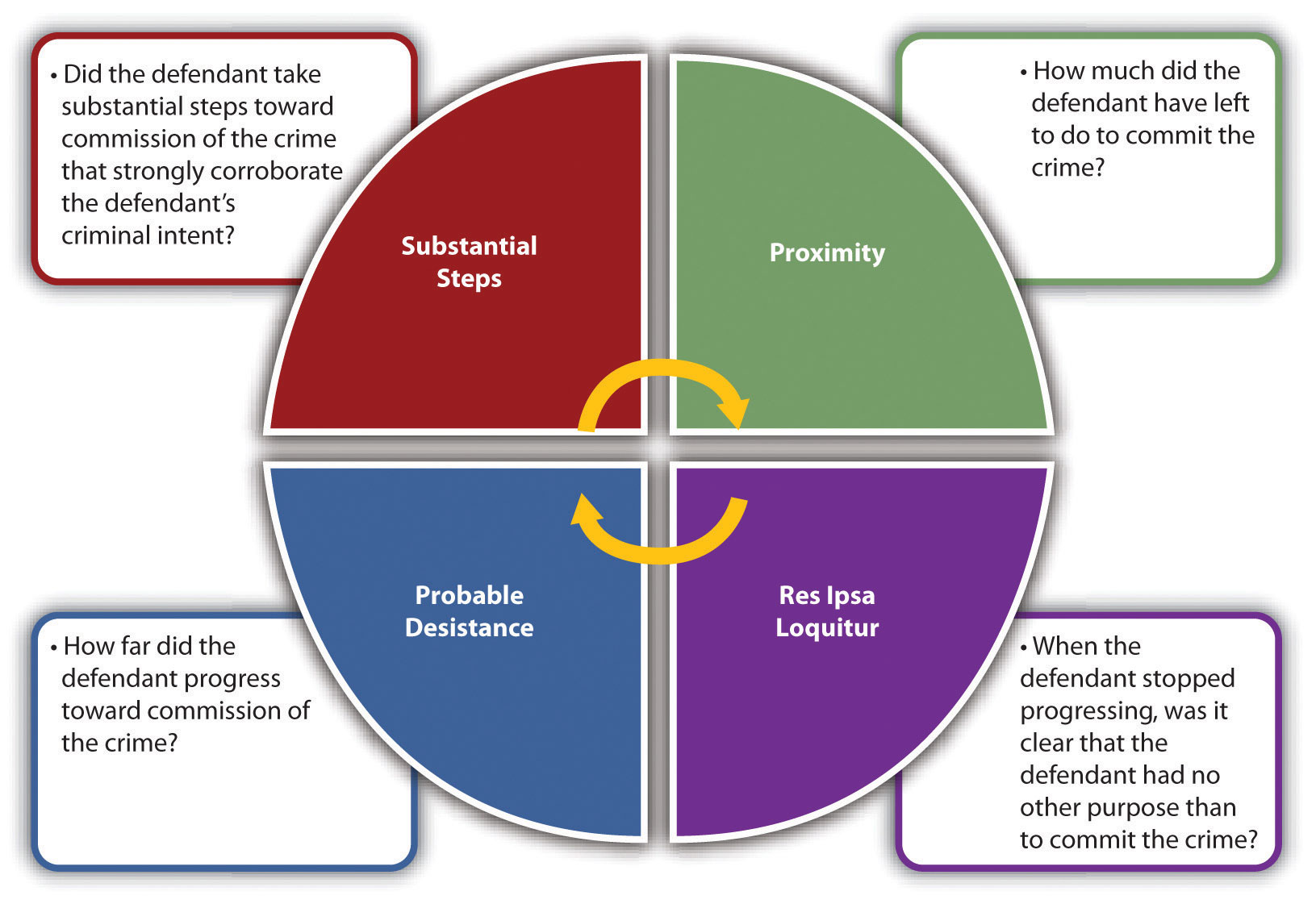
Figure eight.2 Crack the Code
Preparatory Crimes
Some states have statutes criminalizing behavior that would be considered preparatory under any of the four try act tests. For example, some statutes prohibit the mere possession of infiltrator'south tools (Northward.Y. Penal Law, 2010) or even the manufacture of burglar's tools (Conn. Gen. Stat., 2010). A defendant could exist convicted of a preparatory crime and attempt if the criminal human activity element for both is present under the circumstances.
Case of a Preparatory Crime and Attempt
Hal articles a lock pick and takes information technology to the local money shop, which is closed. Hal takes the lock pick out and begins to insert information technology into the coin store doorknob. A security baby-sit apprehends Hal before he is able to pick the lock. If Hal is in a jurisdiction that prohibits the manufacture of burglar'southward tools, he probably could be charged with and convicted of manufacture of burglar'south tools and attempted burglary considering he has committed the criminal human activity element required for both of these offenses.
Attempt Intent
The criminal intent element required for attempt in the majority of jurisdictions is the specific intent or purposely to commit the law-breaking at effect (N.Y. Penal Law, 2010). Generally, no such thing exists equally reckless or negligent endeavor. Thus if the prosecution fails to prove beyond a reasonable doubtfulness that the accused acted purposefully with intent to commit the crime attempted, this could operate as a failure of proof defense.
Example of a Instance Lacking Attempt Intent
Eric is hiking in a jurisdiction that criminalizes reckless burning. Eric pauses in front of a sign that states "Fire Danger Today: High." Eric reads the sign, pulls out a cigarette, lights it, and throws the lit match into some dry brush about the sign. He starts hiking and when he finishes his cigarette, he tosses the lit cigarette butt into some arid grass. Neither the brush nor the grass burns. Eric probably does not have the requisite criminal intent for attempted reckless burning. Endeavor requires purposeful carry. Eric's behave is reckless because he is enlightened of a risk and disregards information technology. If Eric takes the friction match or lit cigarette and tries to ignite a fire with them, it is probable that he has the appropriate criminal intent for attempted arson. Withal, in this example Eric's actions demonstrate devil-may-care behavior that probably is non sufficient for the crime of attempt.
Defenses to Attempt
Along with failure of proof defenses to the criminal act and criminal intent elements, legal impossibility and voluntary abandonment can likewise office as affirmative defenses to attempt in many jurisdictions.
Impossibility equally a Defence force to Attempt
Two types of impossibility defenses exist: legal impossibility, which can part as a defense to attempt, and factual impossibility, which generally cannot. Legal impossibility means that the defendant believes what he or she is attempting to do is illegal, when information technology is non. Factual impossibility means that the accused could not complete the crime attempted because the facts are not as he or she believes them to be. The Model Penal Code disallows factual impossibility as a defense force past stating that conduct is an try when the defendant "purposely engages in carry which would constitute the criminal offense if the attendant circumstances were as he believes them to be" (Model Penal Code § v.01(1) (a)).
Case of Legal Impossibility
Review the case given in Section 8 "Res Ipsa Loquitur Test" with Melissa and Matthew and the attempted poisoning of the neighbor's dog. Assume that Melissa is eighteen. Melissa believes that an individual must exist 20-ane to purchase rat poisonous substance because that is the police force in the state where she lived five years agone. Actually, the state in which Melissa currently resides allows the purchase of rat poison by those who are eighteen or older. The outset store Melissa enters asks for identification when she tries to pay for the rat toxicant, so Melissa makes an alibi and leaves. The second shop Melissa enters does not ask for identification, and she successfully makes the rat poison purchase. Melissa has probably non attempted to purchase rat toxicant illegally in the start store she entered. Melissa'southward act in attempting to purchase the rat poison is legal under the circumstances. Thus her mistaken conventionalities that she is attempting to commit a crime does non transform this legal deed into an illegal one.
Example of Factual Impossibility
Recall from the example given in Department viii "Res Ipsa Loquitur Exam" that Matthew threw a filet coated with rat poison over the fence into the neighbor'due south yard with the intent to poison the neighbour's dog. Both Melissa and Matthew are nether the mistaken conventionalities that the dog is nowadays and will swallow the filet. However, the canis familiaris is on an overnight camping trip with its owners. This mistake of fact probably will not excuse Melissa and Matthew's attempt. Melissa and Matthew purposely engaged in carry that would outcome in the poisoning of the domestic dog if the facts were as Melissa and Matthew believed them to be. Thus Melissa and Matthew have about likely committed attempted devastation of property or fauna cruelty regardless of the fact that their program could not succeed under the circumstances.
Voluntary Abandonment as a Defence force to Attempt
Many jurisdictions let a defendant who voluntarily abandons the planned criminal offence to utilize this abandonment as an affirmative defence force to attempt (Fla. Stat. Ann., 2010). The defense has ii parts. First, the defendant must have a change of heart that is non motivated by an increased possibility of detection, or a modify in circumstances that make the crime's commission more hard. Equally the Model Penal Code states, "it is an affirmative defense that he abased his effort to commit the offense…under circumstances manifesting a consummate and voluntary renunciation of his criminal purpose…[R]enunciation of criminal purpose is not voluntary if it is motivated…past circumstances…which increase the probability of detection…or which make more difficult the accomplishment of the criminal purpose" (Model Penal Code § five.01(four)). Second, the abandonment must exist complete and cannot only exist a postponement. Nether the Model Penal Code, "[r]enunciation is non complete if it is motivated by a conclusion to postpone the criminal conduct until a more than advantageous fourth dimension or to transfer the criminal effort to some other but similar…victim" (Model Penal Code § five.01(iv)). The voluntary abandonment defence force gives defendants incentive to terminate progressing toward consummation of the law-breaking and prevents the crime from occurring without the demand for law enforcement intervention.
Instance of Voluntary Abandonment every bit a Defence force to Attempt
Review the example with Melissa and Matthew in Section viii "Res Ipsa Loquitur Test". If Melissa changes her mind afterwards purchasing the rat poison and talks Matthew out of poisoning the neighbor's domestic dog, Melissa has voluntarily abandoned the crime and cannot exist charged with endeavor. If Matthew changes his mind afterward coating the filet with rat poison and throws the filet abroad, Matthew has voluntarily abased the law-breaking and cannot be charged with endeavour. Note that both Melissa's and Matthew's actions are in the very early on stages of the crime of destruction of property or animal cruelty and probably will be considered preparatory, rather than constituting the criminal act element required for attempt. When Melissa climbs over the debate, picks up the filet, and takes it back to her house for disposal, it is most likely too belatedly to voluntarily carelessness the crime. At this signal, the crime of attempt has already been committed, and neither voluntary abandonment nor factual impossibility can function as defenses.
Merger
Effort merges into the crime if the crime is completed in many jurisdictions, which means that the defendant cannot be charged with attempt and the completed crime (Ga. Lawmaking tit. 16, 2011).
Example of Merger
Review the example with Melissa and Matthew in Section eight "Res Ipsa Loquitur Exam". Change the facts, and assume that the neighbor'south domestic dog eats the poisoned filet and dies. Melissa and Matthew probably cannot exist charged with attempted devastation of property or animal cruelty and devastation of property or animal cruelty in many jurisdictions. Once the crime is complete, the attempt crime merges into the consummated crime, and Melissa and Matthew may be charged only with destruction of property or animal cruelty.
Effigy 8.iii Defenses to Attempt
| Impossibility | |
|---|---|
| Voluntary Abandonment | |
| Merger |
Endeavour and Transferred Intent
Recall from Chapter iv "The Elements of a Offense" that a defendant's criminal intent can transfer from the intended victim to the bodily victim in some jurisdictions. If the intent is transferred, the accused may exist criminally responsible for the consummated offense against the eventual victim and for endeavor confronting the intended victim.
Example of Attempt and Transferred Intent
Review the example with Melissa and Matthew in Section 8 "Res Ipsa Loquitur Test". Change the facts, and presume that the neighbor's cat licks the poison off the filet and thereafter dies. If Melissa and Matthew are in a jurisdiction that recognizes transferred intent, they may be charged with attempted destruction of property or animate being cruelty for trying to poison the neighbor'south dog and destruction of holding or animal cruelty for actually poisoning and killing the neighbor'due south true cat.
Attempt Grading
Jurisdictions vary as to how they grade endeavour. Some jurisdictions follow the common law and grade endeavour lower than the completed criminal offense (Mo. Ann. Stat., 2010). Other jurisdictions punish endeavour the aforementioned every bit the attempted law-breaking, with exceptions for certain specified crimes (Conn. Gen. Stat., 2010).
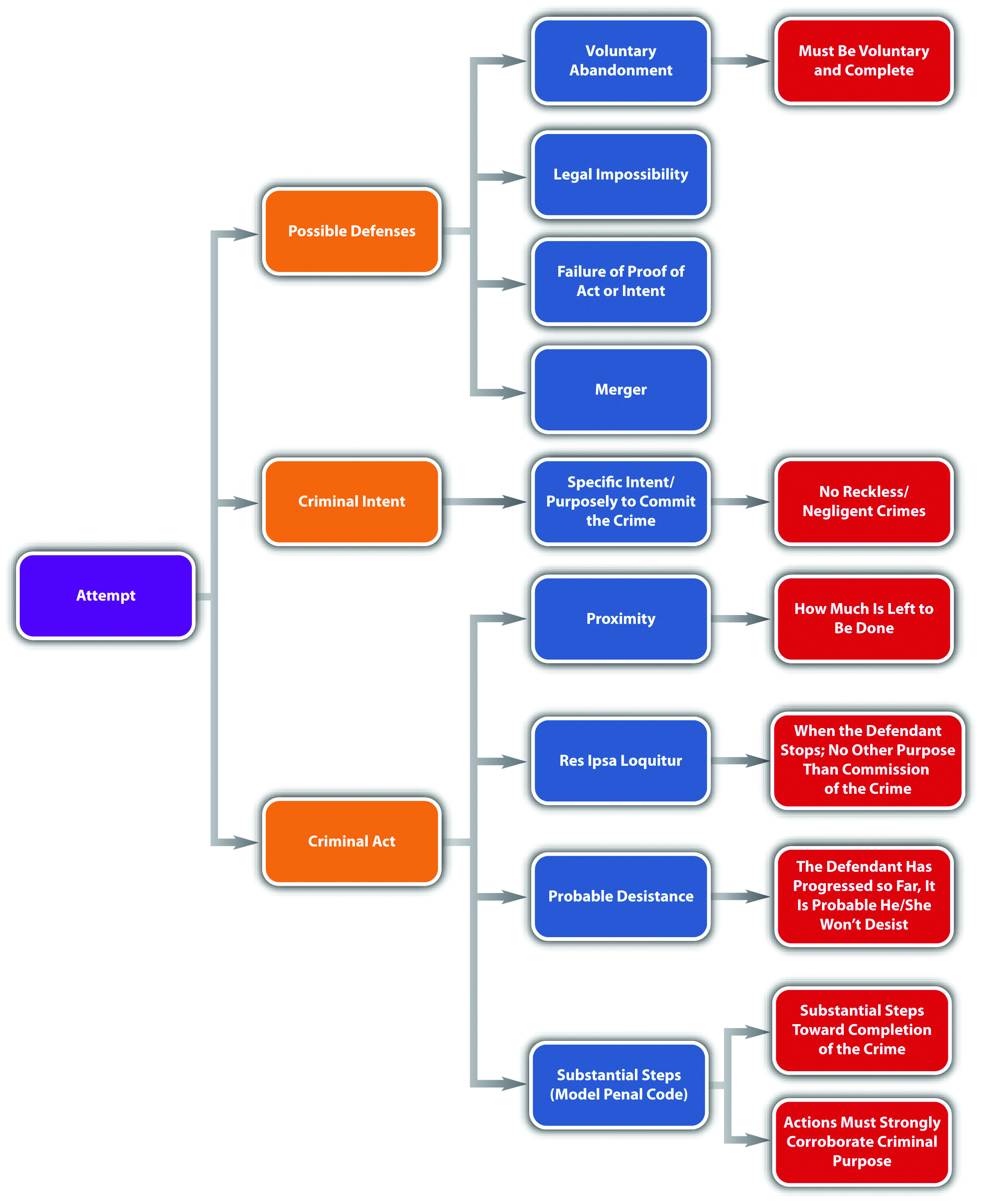
Figure 8.4 Diagram of Attempt
Key Takeaways
- An inchoate crime is a crime that might non be completed.
- General attempt statutes set forth the elements of endeavour and utilise them to any criminal offense. Specific try statutes ascertain attempt according to specified crimes, such as attempted murder, robbery, or rape.
- The four tests jurisdictions utilise to ascertain the criminal act element required for endeavour are proximity, res ipsa loquitur, probable desistance, and substantial steps.
- The proximity exam determines how shut the accused is to committing the crime by analyzing how much is left to accomplish afterwards grooming for the offense.
- The res ipsa loquitur test, also called the unequivocality test, examines the defendant's actions at a moment in time to determine whether the defendant has no other purpose than committing the crime at issue.
- The probable desistance test analyzes whether the defendant has progressed so far that information technology is probable he or she volition non desist without break from law enforcement or other intervening circumstances.
- The substantial steps test is the Model Penal Code examination and ascertains whether the defendant has completed substantial steps toward committee of the crime that are corroborative of the defendant'south criminal intent.
- Preparatory crimes criminalize preparing to commit a crime, which would be a stage that is too premature to plant the criminal human action element required for endeavour.
- The criminal intent element required for endeavor is specific intent or purposely to commit the crime at consequence.
- Bated from failure of proof defenses to effort act and intent, two potential defenses to effort are legal impossibility and voluntary abandonment.
- Factual impossibility means the accused cannot complete the crime because the facts are non equally the defendant believes them to be. Factual impossibility is by and large non a defense to attempt. Legal impossibility means the defendant believes he or she is attempting to commit a crime, but the defendant's actions are actually legal. Legal impossibility is generally a defense to attempt.
- Voluntary abandonment is when the defendant voluntarily and completely withdraws from committee of the offense before it is consummated.
- In many jurisdictions, attempt merges into the crime if it is completed, which means that a accused cannot exist charged with attempt and the completed crime.
- In a jurisdiction that allows for transferred intent, a accused'due south intent can transfer from the intended victim to the bodily victim. The defendant tin can thereafter be criminally responsible for the completed crime against the actual victim and try against the intended victim.
- Some jurisdictions grade attempt lower than the completed criminal offense; others grade attempt the aforementioned as the completed law-breaking, with exceptions.
Exercises
Answer the following questions. Check your answers using the reply key at the stop of the chapter.
- Carol shoots her begetter Carl with malice aforethought. He thereafter lingers in a coma for 2 months and and then dies. Carol is in a jurisdiction that recognizes merger for attempt and that also requires a victim to die within one yr and a day if the accused is to be charged with murder. Can Carol exist charged with attempted murder and murder? Why or why not?
- Read Land v. Withrow, 8 S.W.3d 75 (1999). In Withrow, the accused made frequent visits to a house that was under constabulary enforcement surveillance. While searching the business firm pursuant to a search warrant, law enforcement officers saw the accused emerging from a bedroom that had a locked closet containing a jar with pills dissolving in it, which is the first step of methamphetamine product. The defendant was convicted of attempted methamphetamine production and received a sentence of 18 years in prison. Did the Supreme Court of Missouri uphold the defendant's conviction? The case is bachelor at this link: http://scholar.google.com/scholar_case?case=17239945130468444353&hl=en&as_sdt=2&as_vis=ane&oi=scholarr.
- Read People v. Strand, 539 N.Due west.2d 739 (1995). In Strand, the defendant was convicted of assault with intent to commit attempted kidnapping. Did the Michigan Courtroom of Appeals uphold this conviction? The case is bachelor at this link: http://scholar.google.com/scholar_case?case=1507705469884283003&hl=en&as_sdt=ii&as_vis=1&oi=scholarr.
References
Commonwealth v. Hamel, 52 Mass. App. Ct. 250 (2001), accessed Dec 29, 2010, http://scholar.google.com/scholar_case?instance=3222223363179578849&hl=en&as_sdt=two&as_vis=1&oi=scholarr.
Conn. Gen. Stat. § 53a-106, accessed December 31, 2010, http://www.cga.ct.gov/2009/pub/chap952.htm#Sec53a-106.htm.
Fla. Stat. Ann. § 777.04(5) (a), accessed December 31, 2010, http://law.justia.com/florida/codes/2003/TitleXLVI/chapter777/777_04.html.
Ga. Code tit. 16 § sixteen-four-ii, accessed January 28, 2011, http://law.onecle.com/georgia/16/16-4-2.html.
Grill v. Land, 337 Md. 91 (1995), accessed Dec 27, 2010, http://world wide web.leagle.com/xmlResult.aspx?xmldoc=1995428337Md91_1422.xml&docbase=CSLWAR2-1986-2006.
Hamiel v. Wisconsin, 285 Due north.Due west.2d 639 (1979), accessed Dec 30, 2010, http://scholar.google.com/scholar_case?case=3730801887783687670&hl=en&as_sdt=2002&as_vis=1.
Mo. Ann. Stat. § 564.011, accessed December 31, 2010, http://law.justia.com/missouri/codes/2005/t38/5640000011.html.
N.Y. Penal Police force § 140.35, accessed December 31, 2010, http://police.onecle.com/new-york/penal/PEN0140.35_140.35.html.
People v. Dillon, 668 P.second 697 (1983), accessed December 29, 2010, http://scholar.google.com/scholar_case?example=16336126005486548570&hl=en&as_sdt=two,5.
People five. Luna, 170 Cal. App. 4th 535 (2009), accessed December 27, 2010, http://scholar.google.com/scholar_case?case=11148942163253518924&hl=en&as_sdt=ii&as_vis=1&oi=scholarr.
Schulhofer, S. J. and Dan M. Kahan, "Attempt," encyclopedia.com website, accessed Dec 26, 2010, http://world wide web.encyclopedia.com/topic/Attempt.aspx.
Tex. Penal Code § 15.01, accessed December 27, 2010, http://law.onecle.com/texas/penal/xv.01.00.html.
U.S. 5. Mandujano, 499 F.2nd 370, 373 fn. 5 (1974), accessed Dec 30, 2010, http://ftp.resource.org/courts.gov/c/F2/499/499.F2d.370.74-1445.html.
USLegal.com, "Definition of Res Ipsa Loquitur," accessed Dec 29, 2010, http://definitions.uslegal.com/r/res-ipsa-loquitur.
Yourdictionary.com, accessed December 28, 2010, "Definition of Inchoate," http://world wide web.yourdictionary.com/inchoate.
18 United states of americaC. § 1113, accessed June 28, 2011, http://www.law.cornell.edu/uscode/718/usc_sec_18_00001113—-000-.html.
daileytruirallith1968.blogspot.com
Source: https://open.lib.umn.edu/criminallaw/chapter/8-1-attempt/
0 Response to "Will Burlar Attempt Again After Failed Attempt"
Post a Comment