Postage Stamp Australia International Year of the Family

A postage is a small piece of paper issued past a post part, postal administration, or other authorized vendors to customers who pay postage (the toll involved in moving, insuring, or registering mail), who and then affix the stamp to the face up or address-side of any item of mail—an envelope or other postal comprehend (east.g., parcel, box, mailing cylinder)—that they wish to send. The detail is then processed by the postal system, where a postmark or cancellation mark—in modern usage indicating date and point of origin of mailing—is applied to the postage stamp and its left and right sides to prevent its reuse. The item is and then delivered to its addressee.
E'er featuring the name of the issuing nation (with the exception of the United kingdom of great britain and northern ireland), a denomination of its value, and frequently an illustration of persons, events, institutions, or natural realities that symbolize the nation'due south traditions and values, every stamp is printed on a piece of usually rectangular, but sometimes triangular or otherwise shaped special custom-made paper whose dorsum is either glazed with an agglutinative glue or cocky-adhesive.
Because governments event stamps of different denominations in diff numbers and routinely discontinue some lines and introduce others, and because of their illustrations and clan with the social and political realities of the time of their issue, they are often prized for their dazzler and historical significance by postage stamp collectors whose written report of their history and of mailing systems is called philately. Because collectors oftentimes purchase stamps from an issuing agency with no intention to employ them for postage, the revenues from such purchases and payments of postage tin make them a source of net profit to that bureau. On 1 May 1840, the Penny Black, the kickoff adhesive stamp postage stamp, was issued in the United Kingdom. Within 3 years postage stamp stamps were introduced in Switzerland and Brazil, a little later in the United States, and past 1860, they were in 90 countries effectually the world.[1] The first stamp stamps did not need to show the issuing state, and then no country name was included on them. Thus the Uk remains the only country in the world to omit its name on postage stamps; the monarch's image signifies the Uk as the land of origin.[2]
Invention [edit]

Throughout modern history, numerous methods were used to indicate that postage had been paid on a mailed item, so several different men have received credit for inventing the stamp.
William Dockwra [edit]
In 1680, William Dockwra, an English merchant in London, and his partner Robert Murray established the London Penny Postal service, a mail system that delivered letters and small parcels inside the metropolis of London for the sum of i penny. Confirmation of paid stamp was indicated past the use of a manus stamp to frank the mailed detail. Though this "stamp" was applied to the letter or parcel itself, rather than to a divide piece of newspaper, it is considered by many historians to be the globe's kickoff postage stamp.[3]
Lovrenc Košir [edit]
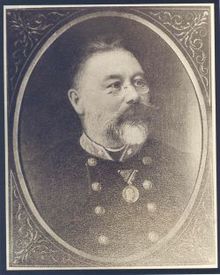
In 1835, the civil servant Lovrenc Košir from Ljubljana in Austria-hungary (now Slovenia), suggested the apply of "artificially affixed postal revenue enhancement stamps"[four] using "gepresste Papieroblate" ("pressed newspaper wafers"), only although civil bureaucrats considered the suggestion in detail, it was not adopted.[5] [6] The 'Papieroblate' were to produce stamps every bit newspaper decals so thin as to prevent their reuse.[7]
Rowland Loma [edit]
In 1836, Robert Wallace, a Member of (British) Parliament, gave Sir Rowland Hill numerous books and documents nearly the mail, which Hill described as a "half hundred weight of material".[viii] [ix] After a detailed study, on 4 January 1837 Loma submitted a pamphlet entitled Post Office Reform: Its Importance and Practicability, marked "individual and confidential", and not released to the full general public, to the Chancellor of the Exchequer, Thomas Spring Rice.[ten] The Chancellor summoned Hill to a meeting at which he suggested improvements and changes to be presented in a supplement, which Hill duly produced and submitted on 28 January 1837.[11]
Summoned to give evidence earlier the Commission for Postal service Part Enquiry on thirteen February 1837, Hill read from the letter he wrote to the Chancellor that included a argument maxim that the notation of paid stamp could be created... by using a bit of newspaper only big plenty to behave the postage stamp, and covered at the back with a pasty launder..."[12] [13] This would eventually get the beginning unambiguous description of a modern adhesive postage stamp stamp (though the term "stamp postage stamp" originated at later date). Soon after, Loma'southward revision of the booklet, dated 22 February 1837, containing some 28,000 words, incorporating the supplement given to the Chancellor and statements he made to the commission, was published and made available to the general public. Hansard records that on 15 December 1837, Benjamin Hawes asked the Chancellor of the Exchequer "whether it was the intention of the Government to give outcome to the recommendation of the Commissioners of the Post-office, contained in their ninth report relating to the reduction of the rates of postage stamp, and the issuing of penny stamps?"[xiv]
Colina's ideas for postage stamp stamps and charging paid-postage based on weight soon took concord, and were adopted in many countries throughout the world.[1] With the new policy of charging by weight, using envelopes for mailing documents became the norm. Hill'south brother Edwin invented a paradigm envelope-making car that folded paper into envelopes quickly enough to match the step of the growing need for postage stamps.[15]
Rowland Hill and the reforms he introduced to the U.k. postal system appear on several of its commemorative stamps.[xv]
James Chalmers [edit]
In the 1881 volume The Penny Postage stamp Scheme of 1837, Scotsman Patrick Chalmers claimed that his father, James Chalmers, published an essay in August 1834 describing and advocating a postage stamp, but submitted no evidence of the essay's beingness. Withal, until he died in 1891, Patrick Chalmers campaigned to have his begetter recognized equally the inventor of the postage stamp.[sixteen]
The kickoff independent bear witness for Chalmers' merits is an essay, dated 8 Feb 1838 and received by the Post Office on 17 February 1838, in which he proposed agglutinative postage stamps to the General Mail Office.[17] In this approximately 800-word document concerning methods of indicating that postage had been paid on mail he states:
- "Therefore, of Mr Hill's plan of a uniform rate of postage... I conceive that the most simple and economic mode... would be past Slips... in the hope that Mr Hill's program may soon be carried into operation I would suggest that sheets of Stamped Slips should be prepared... then be rubbed over on the back with a strong solution of gum...".
Chalmers' original document is at present in the United Kingdom's National Postal Museum.
Since Chalmers used the same postage denominations that Loma had proposed in February 1837, information technology is clear that he was enlightened of Hill's proposals, but whether he obtained a re-create of Hill's booklet or simply read most it in one or both of the ii detailed accounts (25 March 1837[eighteen] and 20 December 1837[19]) published in The Times is unknown. Neither commodity mentioned "a fleck of paper simply large enough to bear the postage", so Chalmers could not have known that Colina had made such a proposal. This suggests that either Chalmers had previously read Hill's booklet and was only elaborating Hill'south thought, or he had independently developed the idea of the modern postage stamp.
James Chalmers organized petitions "for a low and compatible rate of postage". The showtime such petition was presented in the House of Eatables on iv December 1837 (from Montrose).[xx] Further petitions organised past him were presented on 1 May 1838 (from Dunbar and Cupar), 14 May 1838 (from the county of Forfar), and 12 June 1839. At this same time, other groups organised petitions and presented them to Parliament. All petitions for consumer-oriented, low-cost, volume-based postal rates followed publication of Hill'southward proposals.
Other claimants [edit]
Other claimants include or take included[21]
- Dr John Gray of the British Museum
- Samuel Forrester, a Scottish taxation official
- Charles Whiting, a London stationer
- Samuel Roberts of Llanbrynmair, Wales
- Francis Worrell Stevens, schoolmaster at Loughton
- Ferdinand Egarter of Spittal, Austria
- Back-scratch Gabriel Treffenberg from Sweden
History [edit]
The nineteenth century [edit]

Stamp stamps have facilitated the delivery of mail since the 1840s. Before then, ink and hand-stamps (hence the word 'stamp'), usually made from woods or cork, were often used to frank the mail and confirm the payment of stamp. The first adhesive postage stamp, usually referred to as the Penny Black, was issued in the United Kingdom in 1840. The invention of the postage was part of an try to meliorate the postal system in the United Kingdom of Peachy Uk and Ireland,[22] which, in the early 19th century, was in disarray and rife with abuse.[23] At that place are varying accounts of the inventor or inventors of the postage.[24]
Before the introduction of postage stamps, post in the United Kingdom was paid for past the recipient, a system that was associated with an irresolvable problem: the costs of delivering mail were non recoverable by the post when recipients were unable or unwilling to pay for delivered items, and senders had no incentive to restrict the number, size, or weight of items sent, whether or non they would ultimately exist paid for.[25] The postage stamp resolved this issue in a simple and elegant fashion, with the additional benefit of room for an element of beauty to be introduced. Meantime with the first stamps, the United Kingdom offered wrappers for mail. Later related inventions include postal jotter such equally prepaid-stamp envelopes, post cards, lettercards, aerogrammes, postage meters, and, more than recently, specialty boxes and envelopes provided gratis to the client by the U.s.a. Postal Service for priority or express mailing.
The stamp stamp afforded convenience for both the mailer and postal officials, more effectively recovered costs for the post, and ultimately resulted in a amend, faster postal system. With the conveniences stamps offered, their employ resulted in profoundly increased mailings during the 19th and 20th centuries.[26] Postage stamps during this era were the most popular fashion of paying for post; however, by the end of the 20th century were rapidly being eclipsed by the use of metered postage and bulk mailing by businesses.[27] [28]
Every bit postage stamps with their engraved imagery began to appear on a widespread basis, historians and collectors began to take notice.[29] The study of postage stamps and their apply is referred to as philately. Stamp collecting tin can be both a hobby and a form of historical report and reference, equally government-issued postage stamps and their mailing systems have always been involved with the history of nations.[30] [31]
Although a number of people laid claim to the concept of the postage postage stamp, information technology is well documented that stamps were showtime introduced in the Britain of Great Britain and Ireland on 1 May 1840 as a part of postal reforms promoted by Sir Rowland Hill.[1] With its introduction, the postage fee was paid by the sender and not the recipient, though information technology was withal possible to send postal service without prepaying. From when the first postage stamps were used, postmarks were applied to foreclose the stamps beingness used again.[32] [33]
The first postage stamp, the "Penny black", became available for purchase 1 May 1840, to be valid as of vi May 1840. Two days later, eight May 1840, the Two penny blue was introduced. The Penny blackness was sufficient for a alphabetic character less than half an ounce to be sent anywhere within the Great britain. Both stamps included an engraving of the young Queen Victoria, without perforations, as the start stamps were separated from their sheets by cutting them with scissors.
The first stamps did not need to show the issuing state, then no country name was included on them. The Uk remains the only country to omit its proper name on postage stamps,[2] [34] using the reigning monarch's head as country identification. Following the introduction of the postage postage stamp in the United Kingdom, prepaid postage stamp considerably increased the number of letters mailed. Before 1839, the number of letters sent in the United Kingdom was typically 76 million. By 1850, this increased 5-fold to 350 1000000, continuing to grow rapidly[26] until the end of the 20th century when newer methods of indicating the payment of stamp reduced the use of stamps.
Other countries soon followed the United kingdom of great britain and northern ireland with their ain stamps.[1] The Canton of Zürich in Switzerland issued the Zurich 4 and 6 rappen on 1 March 1843. Although the Penny blackness could be used to send a letter less than half an ounce anywhere within the Uk, the Swiss did not initially adopt that arrangement, instead continuing to calculate mail rates based on distance to be delivered. Brazil issued the Bull'due south Centre postage stamp on ane August 1843. Using the same printer used for the Penny blackness, Brazil opted for an abstract blueprint instead of the portrait of Emperor Pedro Two, and then his image would not exist disfigured by a postmark.
In 1845, some postmasters in the United States issued their ain stamps, but information technology was not until 1847 that the first official United states stamps were issued: 5 and 10 cent issues depicting Benjamin Franklin and George Washington.[35] A few other countries issued stamps in the belatedly 1840s. The famous Republic of mauritius "Postal service Role" stamps were issued by Mauritius in September 1847. Many others, such equally India, started their use in the 1850s, and by the 1860s almost countries issued stamps.
Perforation of postage stamps began in January 1854.[36] The first officially perforated stamps were issued in Feb 1854. Stamps from Henry Archer'southward perforation trials were issued in the last few months of 1850; during the 1851 parliamentary session[36] at the House of Commons of the United Kingdom; and finally in 1853/54 after the Great britain government paid Archer £4,000 for his motorcar and the patent.[36]
The Universal Postal Union, established in 1874, prescribed that nations shall only effect postage stamps co-ordinate to the quantity of real use, and no living persons shall exist taken equally subjects. The latter dominion lost its significance after World War I.[37]
The twentieth and twenty-commencement century [edit]
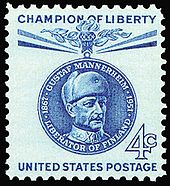
After World War II, it became customary in some countries, particularly small Arab nations, to consequence postage stamps en masse as it was realized how profitable that was.[37]
During the 21st century, the corporeality of mail — and the use of postage stamps, accordingly — has reduced in the world because of electronic mail and other technological innovations. Iceland has already announced that it will not issue new stamps for collectors anymore because the sales have decreased and in that location are plenty stamps in the stock.[37]
Design [edit]
When the first postage stamps were issued in the 1840s, they followed an about identical standard in shape, size and general field of study matter. They were rectangular in shape. They bore the images of Queens, Presidents and other political figures. They too depicted the denomination of the postage stamp-paid, and with the exception of the United Kingdom,[note ane] depicted the name of the country from which issued.[note 2] Nearly all early on postage stamps depict images of national leaders only.
Soon after the introduction of the postage stamp stamp, other subjects and designs began to appear. Some designs were welcome, others widely criticized. For case, in 1869, the United States Postal service Part broke tradition of depicting presidents or other famous historical figures, instead using other subjects including a train, and horse.(See: 1869 Pictorial Issue.) The change was greeted with general disapproval, and sometimes harsh criticism from the American public.[39] [40]
Perforations [edit]

Rows of perforations in a sheet of postage stamps.

The Penny Cherry-red, 1854 issue. The first officially perforated postage postage.
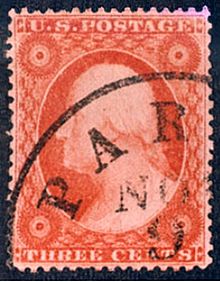
The first officially perforated United States stamp (1857).
Perforations are small holes fabricated between individual postage stamps on a sail of stamps,[41] facilitating separation of a desired number of stamps. The resulting frame-like, rippled edge surrounding the separated postage defines a characteristic meme for the appearance of a postage stamp.
In the first decade of postage stamps' existence (depending on the country), stamps were issued without perforations. Scissors or other cutting mechanisms were required to separate a desired number of stamps from a full sheet. If cutting tools were non used, individual stamps were torn off. This is evidenced by the ragged edges of surviving examples. Mechanically separating stamps from a sail proved an inconvenience for postal clerks and businesses, both dealing with large numbers of private stamps on a daily basis. Past 1850, methods such every bit rouletting wheels were beingness devised in efforts of making postage separation more convenient, and less time-consuming.[42]
The United Kingdom was the start country to upshot postage stamp stamps with perforations. The starting time machine specifically designed to perforate sheets of stamp stamps was invented in London past Henry Archer, an Irish landowner and railroad man from Dublin, Republic of ireland.[43] The 1850 Penny Red[42] [44] [45] was the first postage stamp to exist perforated during trial course of Archer's perforating motorcar. Subsequently a period of trial and error and modifications of Archer'due south invention, new machines based on the principles pioneered by Archer were purchased and in 1854 the United Kingdom postal authorities started continuously issuing perforated postage stamps in the Penny Crimson and all subsequent designs.
In the U.s.a., the apply of stamp stamps defenseless on quickly and became more than widespread when on 3 March 1851, the last 24-hour interval of its legislative session, Congress passed the Act of March 3, 1851 (An Act to reduce and alter the Rates of Postage stamp in the United States).[46] Similarly introduced on the last solar day of the Congressional session iv years later, the Act of March iii, 1855 required the prepayment of stamp on all mailings. Thereafter, stamp employ in the United states of america quickly doubled, and by 1861 had quadrupled.[42]
In 1856, nether the direction of Postmaster Full general James Campbell, Toppan and Carpenter, (commissioned by the The states authorities to impress U.s. postage stamps through the 1850s) purchased a rotary machine designed to separate stamps, patented in England in 1854 by William and Henry Bemrose, who were printers in Derby, England.[47] The original auto cut slits into the paper rather than punching holes, just the auto was soon modified.[44]
The first stamp result to be officially perforated, the 3-cent George Washington, was issued by the United states of america Mail service Office on 24 February 1857. Betwixt 1857 and 1861, all stamps originally issued between 1851 and 1856 were reissued with perforations. Initial capacity was insufficient to perforate all stamps printed, thus perforated issues used betwixt Feb and July 1857 are scarce and quite valuable.[48] [49]
Shapes and materials [edit]
In addition to the well-nigh mutual rectangular shape, stamps have been issued in geometric (circular, triangular and pentagonal) and irregular shapes. The Us issued its kickoff circular stamp in 2000 as a hologram of the World.[50] [51] Sierra Leone and Tonga accept issued stamps in the shapes of fruit. Stamps that are printed on sheets are generally separated by perforations, though, more than recently, with the appearance of gummed stamps that exercise not accept to be moistened prior to affixing them, designs tin can comprise smooth edges (although a purely decorative perforated edge is often present).
Stamps are most normally fabricated from paper designed specifically for them, and are printed in sheets, rolls, or modest booklets. Less commonly, postage stamps are made of materials other than newspaper, such equally embossed foil (sometimes of gold). Switzerland made a postage that contained a flake of lace and 1 of wood. The Usa produced ane of plastic. Due east Deutschland issued a postage of synthetic chemicals. In holland a stamp was made of silver foil. Bhutan issued one with its national canticle on a playable record.[52]
Graphic characteristics [edit]

The 1985 postage stamp for 115th nascence anniversary of Vladimir Lenin. Portrait of Lenin (based on a 1900 photography of Y. Mebius in Moscow) with the Tampere Lenin Museum.
The subjects institute on the face of postage stamps are by and large what defines a particular stamp upshot to the public and are often a reason why they are saved by collectors or history enthusiasts. Graphical subjects constitute on postage stamps take ranged from the early portrayals of kings, queens and presidents to subsequently depictions of ships, birds and satellites,[40] famous people,[53] historical events, comics, dinosaurs, hobbies (knitting, stamp collecting), sports, holiday themes, and a wealth of other subjects besides numerous to list.
Artists, designers, engravers and authoritative officials are involved with the selection of subject field matter and the method of press stamps. Early on stamp images were almost e'er produced from an engraving — a design etched into a steel dice, which was then hardened and whose impression was transferred to a printing plate. Using an engraved image was deemed a more secure manner of printing stamps equally information technology was nearly incommunicable to counterfeit a finely detailed epitome with raised lines for anyone but a primary engraver. In the mid-20th century, postage stamp issues produced by other forms of printing began to emerge, such as lithography, photogravure, intaglio and spider web offset printing. These later printing methods were less expensive and typically produced images of lesser quality.
Types [edit]

A Costa Rica Airmail stamp of 1937.
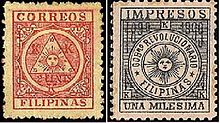

Earth
- Airmail stamp – for payment of airmail service. The term "airmail" or an equivalent is usually printed on special airmail stamps. Airmail stamps typically depict images of airplanes and/or famous pilots and were used when airmail was a special type of mail delivery separate from mail service delivered by train, send or auto. Aside from postal service with local destinations, today almost all other mail service is transported by aircraft and thus airmail is now the standard method of delivery.[54] Scott has a separate category and listing for Us Airmail Postage. Prior to 1940, Scotts Catalogue did not have a special designation for airmail stamps.[55] The diverse major postage catalogs have different numbering systems and may not always list airmail stamps the same manner.
- ATM postage — stamps dispensed by automates and get their value imprinted only at the fourth dimension of purchase.
- Booklet stamp – stamps produced and issued in booklet format.
- Carrier'southward stamp.
- Certified mail stamp.
- Cinderella stamp
- Coil stamps – tear-off stamps issued individually in a vending motorcar, or purchased in a curlicue.
- Commemorative stamp – a stamp that is issued for a limited time to commemorate a person or event. Anniversaries of birthdays and historical events are amid the almost mutual examples.
- Figurer vended postage – advanced secure postage that uses information-based indicia (IBI) technology. IBI uses a two-dimensional bar code (Datamatrix or PDF417) to encode the originating address, date of mailing, postage and a digital signature to verify the stamp.[56]
- Customised stamp – a stamp on which the image can be called by the purchaser by sending in a photograph or past use of the computer. Some are not truthful stamps just technically meter labels.
- Definitive stamps – stamps for everyday postage and are ordinarily produced to come across current postal rates. They often have less appealing designs than commemoratives, though there are notable exceptions.[57] The same design may be used for many years. The use of the same design over an extended period may pb to unintended colour varieties. This may make them just as interesting to philatelists as are commemoratives. A good case would be the US 1903 regular issues, their designs being very picturesque and ornamental.[57] Definitive stamps are oft issued in a series of stamps with different denominations.
- Express mail service postage stamp / special delivery stamp.
- Tardily fee postage – issued to show payment of a fee to let inclusion of a letter or package in the outgoing dispatch although it has been turned in afterwards the cut-off fourth dimension.
- Local post stamps – used on post in a local mail service; a mail service that operates only inside a limited geographical surface area, typically a city or a unmarried transportation route. Some local posts have been operated by governments, while others, known equally individual local posts, take been operated by for-profit companies.
- Make upwardly stamp - a postage with a very small value, used to brand upwardly the difference when postage rates are increased.
- Armed services postage stamp – stamp for a country'due south armed forces, normally using a special postal system.
- Minisheet – a commemorative issue smaller than a regular full sheet of stamps, but with more than i postage stamp. Minisheets oft incorporate a number of different stamps, and frequently having a decorative border. See also gift sheets.
- Newspaper stamp – used to pay the cost of mailing newspapers and other periodicals.
- Official postal service postage – issued for apply by the government or a authorities agency.
- Occupation stamp – a stamp for use past an occupying army or past the occupying army or authorities for utilise past civilians
- Non-denominated postage – postage stamp that remains valid even after the price has risen. Also known as a permanent or "forever" stamp.
- Overprint - A regularly issued stamp, such as a commemorative or a definitive event, that has been changed afterward issuance by "printing over" some office of the stamp. Denominations tin exist changed in this manner.
- Perforated stamps – while this term unremarkably refers to perforations around a stamp to carve up a canvass into individual stamps, it can too exist used for stamps perforated beyond the middle with letters or a pattern or monogram, which are known as "perfins". These modified stamps are usually purchased by corporations to baby-sit against theft by employees.
- Personalised stamps – allow the user to add their own image.
- Pneumatic mail stamps – for mail service sent using pressurized air tubes, only produced in Italian republic.
- Postage and revenue stamps – stamps which were equally valid for postal and financial utilise
- Postage stamp currency postage stamps used as currency rather than as stamp
- Postage due – a postage stamp showing that the full postage has non been paid, and indicating the amount owed. The U.s. Mail Role Department has issued "parcel postal service stamp due" stamps.
- Postal tax – a postage stamp indicating that a tax above the postage charge per unit required for sending letters has been paid. This is often mandatory on postal service issued on a particular twenty-four hours or for a few days.
- Poster postage stamp
- Cocky-agglutinative postage stamp – not requiring moisture to stick. Self-sticking.
- Semi-postal / charity stamp – a stamp with an additional charge for charity. The utilize of semi-postal stamps is at the option of the purchaser. Countries such as Belgium and Switzerland that often use charitable fund-raising pattern stamps that are desirable for collectors.
- Gift sail – a commemorative issue in large format valid for postage stamp oft containing a perforated or imperforate postage every bit part of its blueprint. See besides minisheet.
- Specimen stamp – sent to postmasters and postal administrations so that they are able to identify valid stamps and to avoid forgeries.
- Test stamp – a label not valid for postage, used by postal government to test sorting and cancelling machines or machines that can notice a postage on an envelope. May also be known as dummy or preparation stamps.
- Variable value stamps - dispensed by machines that print the price of the postage stamp at the fourth dimension the stamp is dispensed.
- War taxation postage – A variation on the postal tax stamp to defray the cost of war.
- Water-activated stamp – for many years, h2o-activated stamps were the only type available, and so this term entered into utilize with the advent of self-adhesive stamps. The adhesive or gum on a water-activated stamp must be moistened (usually by licking, thus the stamps are too known equally "lick and stick").
Apart from these, there are likewise Revenue (used to collect taxes or fees on items such every bit documents, tobacco, alcoholic drinks, hunting licenses and medicines) and Telegraph stamps (for sending telegrams), which fall in a dissever category from postage stamps.
Showtime day covers [edit]

Postage stamp stamps are offset issued on a specific appointment, often referred to as the First day of result. A first day cover usually consists of an envelope, a stamp stamp and a postmark with the date of the postage's first day of issue thereon.[58] Starting in the mid-20th century some countries began assigning the beginning day of consequence to a place associated with the subject of the stamp design, such as a specific boondocks or city.[59] There are ii bones types of First Day Covers (FDCs) noted by collectors. The start and often well-nigh desirable blazon among advanced collectors is a cover sent through the mail service in the course of everyday usage, without the intention of the envelope and stamp ever existence retrieved and collected. The second blazon of FDC is ofttimes referred to every bit "Philatelic", that is, an envelope and postage sent by someone with the intention of retrieving and collecting the mailed item at a later fourth dimension and place. The envelope used for this blazon of FDC often bears a printed design or cachet of its own in correspondence with the stamp'southward discipline and is ordinarily printed well in advance of the start day of event date. The latter type of FDC is usually far more than mutual, and is usually inexpensive and relatively easy to acquire. Covers that were sent without whatsoever secondary purpose are considered non-philatelic and oft are much more challenging to discover and collect.[58] [59]
Souvenir or miniature sheets [edit]
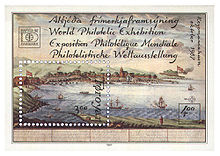
Postage stamps are sometimes issued in souvenir sheets or miniature sheets containing ane or a small number of stamps. Souvenir sheets typically include boosted artwork or information printed on the selvage, the border surrounding the stamps. Sometimes the stamps brand upward a greater moving-picture show. Some countries, and some issues, are produced every bit private stamps also equally sheets.
Stamp collecting [edit]

Stamp collecting is a hobby. Collecting is non the aforementioned as philately, which is defined as the study of stamps. The creation of a valuable or comprehensive collection, however, may require some philatelic noesis.
Stamp collectors are an important source of acquirement for some minor countries that create limited runs of elaborate stamps designed mainly to be bought by stamp collectors. The stamps produced by these countries may far exceed their postal needs. Hundreds of countries, each producing scores of different stamps each year, resulted in 400,000 different types of stamps in beingness by the year 2000. Annual world output averages near ten,000 types.
Some countries authorize the production of postage stamps that have no postal use,[notation 3] only are intended instead solely for collectors. Other countries issue large numbers of low denomination stamps that are bundled together in starter packs for new collectors. Official reprints are frequently printed by companies who have purchased or contracted for those rights and such reprints come across no postal employ.[60] [61] All of these stamps are often found "canceled to guild", pregnant they are postmarked without always having passed through the postal system. Nearly national postal service offices produce stamps that would not exist produced if there were no collectors, some to a far more prolific degree than others.
Sales of stamps to collectors who do not use them for mailing can consequence in big profits. Examples of excessive issues take been the stamps produced by Nicholas F. Seebeck and stamps produced for the component states of the United Arab Emirates. Seebeck operated in the 1890s equally an agent of Hamilton Bank Note Company. He approached Latin American countries with an offer to produce their entire stamp needs for gratuitous. In return. he would have exclusive rights to market stamps to collectors. Each year a new consequence would be produced, but would expire at the end of the year. This bodacious Seebeck of a standing supply of remainders.[60] [61] In the 1960s, printers such every bit the Barody Stamp Company contracted to produce stamps for the separate Emirates and other countries. The sparse population of the desert states fabricated information technology wholly unlikely that many of these stamps would ever be used for mailing purposes, and earned them the name of the "sand dune" countries.[ citation needed ]
Famous stamps [edit]

- Basel Pigeon
- British Guiana 1c magenta
- Hawaiian Missionaries
- Inverted Head iv Annas
- Inverted Jenny
- Republic of mauritius "Post Office"
- Penny Black
- Cherry Revenue "Small One Dollar"
- Scinde Dawk
- Treskilling Yellow
- Uganda Cowries
See besides [edit]
- Artistamp
- Cancellation (mail)
- List of entities that take issued postage stamps (A–E)
- Listing of entities that have issued postage stamp stamps (F–Fifty)
- Listing of entities that have issued postage stamp stamps (M–Z)
- Listing of stamp catalogues
- Mail service Fine art
- Philatelic fakes and forgeries
- Stamp catalog
Notes [edit]
- ^ When the Universal Postal Spousal relationship began requiring the name of the country on stamps used in the international mails, the United Kingdom, as traditionally beingness the first land to issue stamps for postage, never put the country proper name on their stamps.[38]
- ^ Stamps not intended for international mail, such every bit postage due stamps, practise non need to have the country's name.
- ^ Meet, for case, the low value Afghanistan problems of 1964.
References [edit]
- ^ a b c d "The Penny Post revolutionary who transformed how we send letters". BBC. Retrieved xiv August 2019.
- ^ a b Garfield, Simon (January 2009). The Error World: An Matter with Stamps. Boston: Houghton Mifflin Harcourt. p. 118. ISBN978-0-fifteen-101396-8.
- ^ "William Dockwra and the Penny Mail service Service". Canadian Museum of Civilization. Retrieved 8 November 2010.
- ^ "New Issues: Technical Details: Lovrenc Košir" Stanley Gibbons, archived on 10 May 2011 by Net Archive
- ^ Lovrenc Košir stampdomain.com 2012. Retrieved 1 March 2012. Archived here.
- ^ "Meet the new Rowland Loma" in Gibbons Stamp Monthly, April 1949, p. 85
- ^ A History of Victorian Postage By Gerard Cheshire, 2017, ISBN 1445664380, [1]
- ^ The Life of Sir Rowland Loma, p.246
- ^ Hill, Rowland & Hill, George Birkbeck, The Life of Sir Rowland Hill and the History of the Penny Mail service, Thomas De La Rue, 1880, p.242
- ^ Muir, Douglas N, Postal Reform & the Penny Blackness, National Postal Museum, 1990, p.42
- ^ The Life of Sir Rowland Colina, p.264
- ^ The Life of Sir Rowland Loma, p.269
- ^ The Ninth Report of the Commissioners appointed to inquire into the Management of the Mail-function Department, 1837, p.32
- ^ "Hansard, 15 December 1837".
- ^ a b "The British Postal Museum & Archive, Rowland Hill's Postal Reforms".
- ^ Chalmers, Patrick, The Penny Postage Scheme of 1837, Effingham Wilson, 1881
- ^ "James Chalmers essay of 1837". Archived from the original on 13 May 2011. Retrieved 11 November 2009.
- ^ The Times, 25 March 1837
- ^ The Times, twenty Dec 1837
- ^ "Hansard 4 Dec 1837".
- ^ Mackay, James, The Guinness Book of Stamps Facts & Feats, pp.73-74, Guinness Superlatives Limited, 1982, ISBN 0-85112-241-8
- ^ "British Postal Museum, The Penny Post and After".
- ^ National Postal Museum: Globe'due south First Stamp Stamps
- ^ "Before the Penny Blackness, by Ken Lawrence, 1995".
- ^ "Cost of Stamps".
- ^ a b "The British Postal Museum". Archived from the original on 13 May 2011. Retrieved 30 July 2010.
- ^ Pitney-Bowes Postage Meter Visitor Extract: (Inbound the terminal decade of the century, Atomic number 82 saw its sales surpass the US$iii billion marking for the get-go time in company history, topping off at US$3.ii billion in fiscal 1990.
- ^ "United States Postal Service".
- ^ "The Life and Times of a Stamp Collector".
- ^ "Smithsonian National Postal Museum".
- ^ Postal Service Act
- ^ Photo of two covers bearing the First US Postage stamp stamps showing cancellations
- ^ "Smithsonian National Postal Museum".
- ^ O'Donnell, Kevin; Winger, Larry (1997). Internet for Scientists. CRC Press. p. 19. ISBN90-5702-222-two.
- ^ A Sharp Eye on collecting US Classics (Sharp Photography Publications, 2021) ASIN B091MBTGJ7 (read online)
- ^ a b c Why has a Stamp a Perforated Edge? — A.M. Encyclopedia — Volume Two — page 1415
- ^ a b c Appelberg, Carl (iv January 2020). "Snart är frimärkets saga all" [The story of postage postage stamp coming to an end]. Hufvudstadsbladet (in Swedish). Helsingfors. p. 33.
- ^ Miller, Rick (2003) "Refresher Course: Symbols tin be useful in identifying stamps" Linn's Stamp News 10 March 2003, archived here by Internet Archive on 28 Dec 2010
- ^ "The U.Due south. Philatelic Classics Society".
- ^ a b Kenmore Collectors Catalogue, 2010
- ^ "Glossary of Terms". American Philatelic Society. 2017. Retrieved 7 July 2017.
- ^ a b c "Smithsonian National postal Museum: Early Perforation Machines".
- ^ "Ffestiniog Railway Co". Archived from the original on 21 April 2007. Retrieved 14 September 2010.
- ^ a b "Linn'southward Stamp News, Refresher Form, Janet Klug".
- ^ Stanley Gibbons Ltd, Specialised Postage Catalogue Volume i: Queen Victoria (eighth ed. 1985) p. 207
- ^ National Postal Museum, Charles Toppan & Co.,
- ^ "The National Archives".
- ^ Kenmore Collector'southward Catalog, 2010, #906.
- ^ "Hobbizine".
- ^ "Holography: Into the Hereafter". National Postal Museum. Retrieved 22 January 2011.
- ^ "Start round United States postage stamp postage stamp on the way, and that'south non all..." Seattle Post-Intelligencer. Associated Printing. 14 June 2000. Retrieved 22 January 2011.
- ^ "Kingdom of bhutan - Talking Stamps and Other World Firsts!". Sandafayre (Holdings) Ltd. Retrieved 19 May 2013.
- ^ Thomas Mallon Archived 20 October 2007 at archive.today "Stamp: Sober Superheroes", American Heritage, November/Dec 2006
- ^ "United states of america Postal service / Airmail". Archived from the original on 23 June 2011. Retrieved 31 July 2010.
- ^ "Linn's Stamp News, Refresher Form".
- ^ "USPS.com".
- ^ a b Scotts Usa Catalogue, 1903 Issue
- ^ a b "American First Day Embrace Society".
- ^ a b Scotts U.s. Postage stamp Catalogue, First Day of Consequence Index.
- ^ a b "The Stamp Collecting Blog, Seebeck reprints".
- ^ a b National Postal Museum — Excerpt: Etheridge would have the remainders and reprint rights for the philatelic market. Etheridge sold these rights to Nicholas Seebeck, whose Hamilton Banking company Annotation Company issued Ecuador's 1892, 1894, and 1895 stamps....
External links [edit]
 | Wikimedia Commons has media related to Stamps. |
- Stamp Collecting News — Provides updates on new stamp issues from effectually the world
- History of postage stamps and collecting of stamps
- First Postage Stamps
- A Brief History Of Stamps
daileytruirallith1968.blogspot.com
Source: https://en.wikipedia.org/wiki/Postage_stamp
0 Response to "Postage Stamp Australia International Year of the Family"
Post a Comment